Greetings from Fairbanks
Happy New Year from the chilly North
I just got back to Fairbanks after a few weeks back East. It was -35F when I got home last night, and I woke up to six-ish inches of fresh snow this morning (and by that I mean I peeked outside around 10am when the grey pre-sunrise light started filtering into the living room). It is wild to say, but this temperature is a warmer and welcome change from the -40s and even -50s that settled in over the holidays. Yikes. (Update because I am sending this out on Monday morning: there is a low of -47F tonight!)
Today I’m already reminded of how much the pace here depends on weather. My car has mercifully been hibernating in our shared garage while I was gone, but I will need to plug it in (part of the mandatory car winterization I had done this fall) for a few hours before I can even think of starting it. And we will need to shovel out my roommates’ cars before I can leave the garage. That is a tomorrow problem. Instead of wrestling with all that today, I spent a cozy day inside rearranging our living room, unpacking art, making coffee, and attending to some computer work while enjoying the warm weight of Goose asleep on my legs.
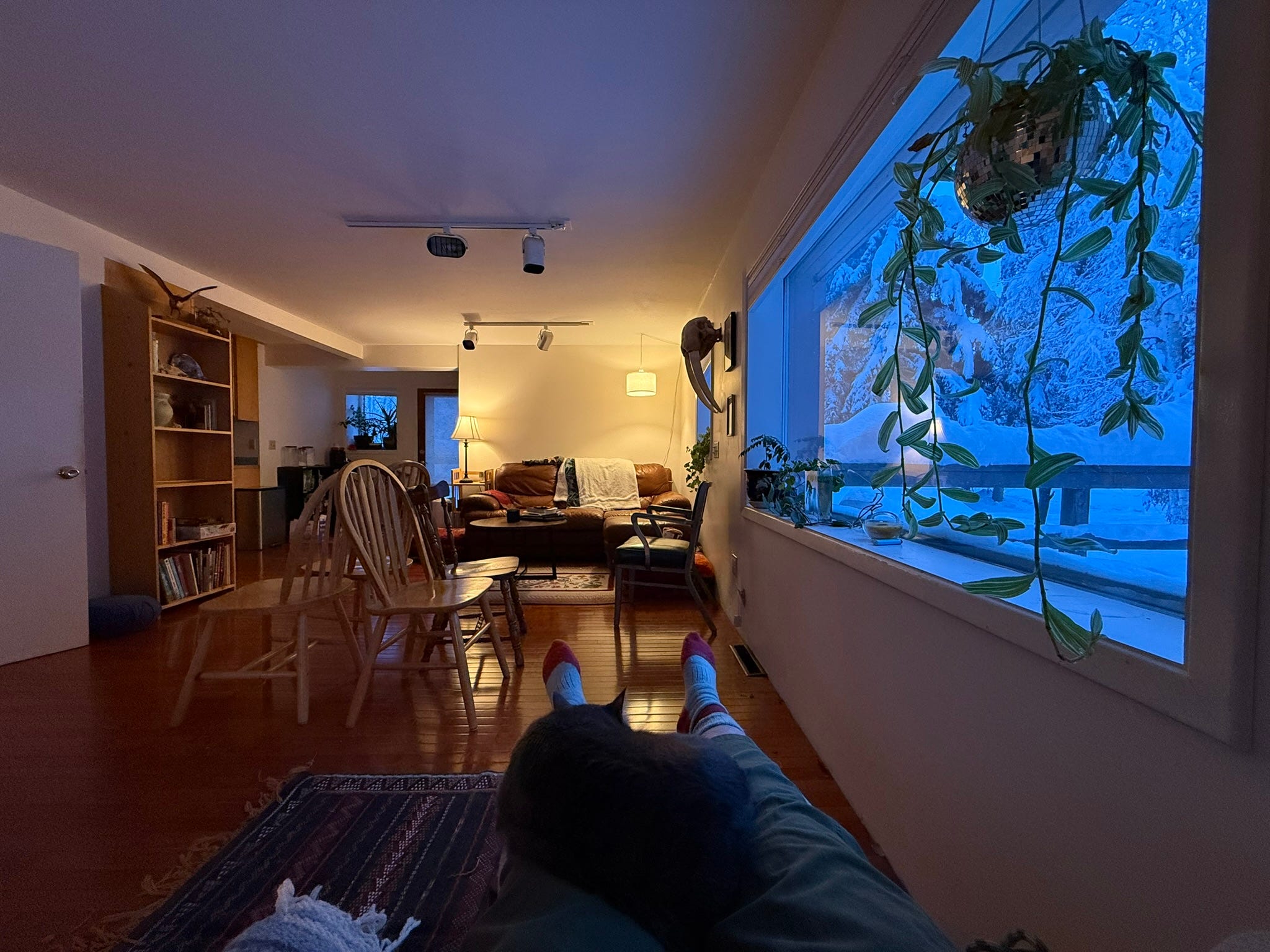
My roommates and I are trying to find a big rug for the living room (in addition to a dining table), but I’m reminded of our remoteness in that it is impossibly expensive and impractical to ship something like that here, we don’t want something synthetic and poorly made from Walmart of Fred Meyer, and facebook marketplace is pretty picked over at the moment. My roommate is amazing at finding free stuff at the transfer station where we bring our trash, but no luck on the rug.
As such, there is a real necessity here to make and mend things because of these challenges. It is not an exaggeration to say that everyone I have met here is incredibly creative and talented and scrappy. This also playing into the weather/seasonal-pace, as having indoor activities is important when there is just a few hours of very cold daylight and the sun doesn’t rise above treeline. Anyway, my lowkey day feels like a nice reset after a whirlwind of holiday visits, dodging (and then succumbing) to the headcold that seems to have worked its way through everyone I know this past month.
This quiet coziness feels like a precious and possibly undeserved balm during a downright insane time to be alive? I have found myself in many many doom scroll rabbit holes about the state of the country, climate, colonialism, etc etc etc. If you also feel overwhelmed and anxious and confused, I see you and I feel you. <3
PhD Work
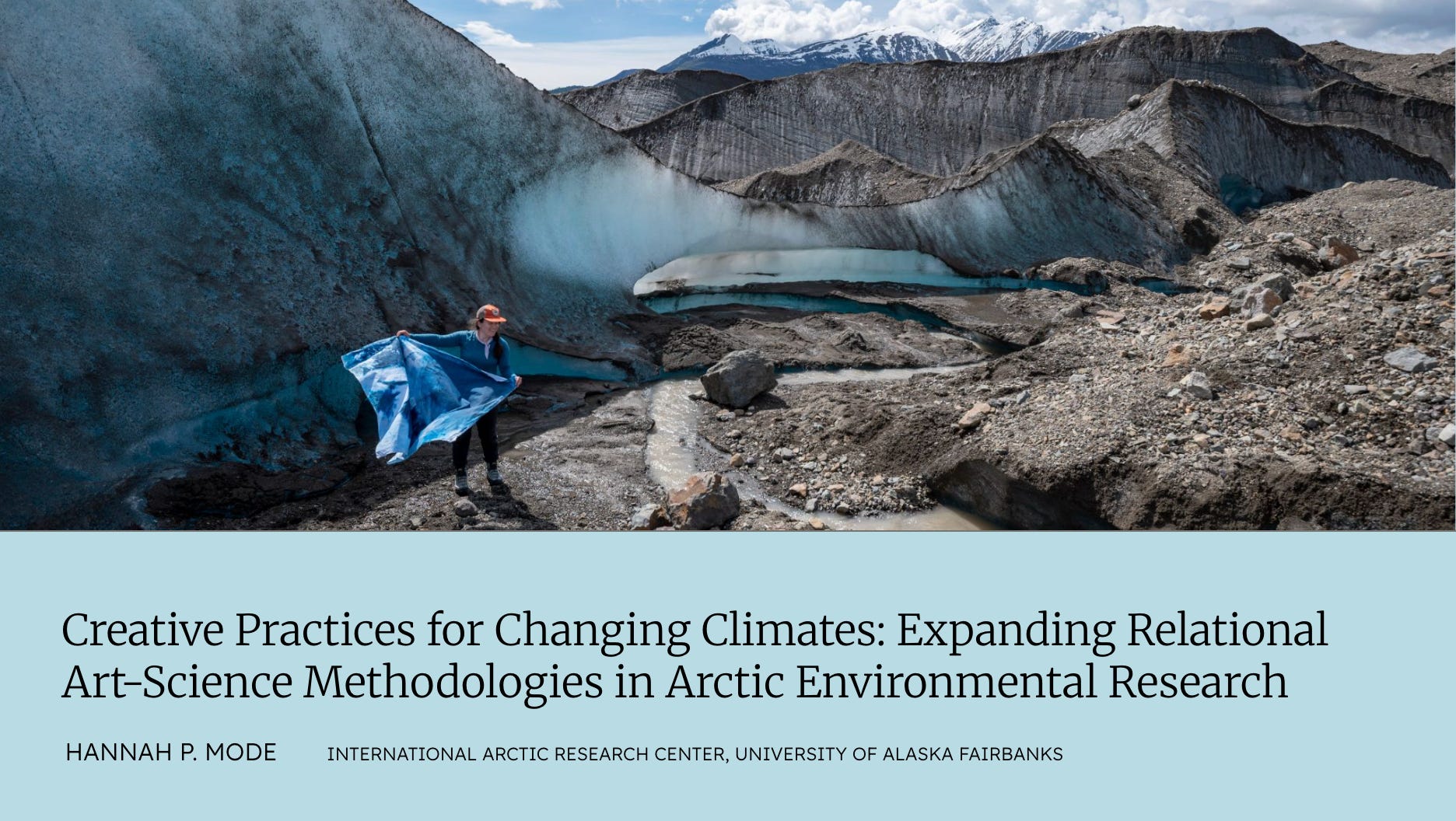
ICYMI, I moved to Fairbanks this summer to pursue an Interdisciplinary PhD at University of Alaska Fairbanks! I am based out of the International Arctic Research Center, working with Dr. Kristin Timm. My dissertation investigates how artistic practice can be integrated into Arctic and sub-Arctic fieldwork, and how such integration reshapes pedagogy, collaboration, and knowledge production. If you know me, then you know that this inquiry grew organically from the past 10 years (!) of working alongside scientists and educators in glacial environments, where I recognized a persistent gap: art is often treated only as a tool for communication (art-as-product), rather than as a process that can generate knowledge in its own right (art-as-process). My research draws upon scholarship across fields – including critical theory, aesthetics, community-engaged research, glaciology, Indigenous and traditional knowledge, sustainability, and myriad art practices –
to support a rigorous and emergent transdisciplinary research path at a time of accelerating climate change in the Arctic. Ultimately I’m hoping to help formalize new frameworks to move beyond disciplinary silos and cultivate ethical, inclusive, and relational approaches to research.
New Year, Less Polished
I have been meaning to send out a newsletter update with lots of life news for months now. Obviously I have not succeeded in doing so, and I think it comes down to that all-or-nothing, perfectionist-to-procrastination loop that plagues a lot of us. So I’m going to try something different for 2026 in my little corner of substack. Inspired by my personal favorite substack, Process Pending by my bestie-collaborator-colleague Elizabeth Case, am going to try to write more updates, but that feel more in-progress and less of a finished product. Honestly, that is partly why I started writing this in 2020 (howww was that 5 years ago and also a lifetime???), but somewhere along the line it took a hard turn into the slightly more prefunctery update land instead of staying in the unpolished WIP state that feels way easier to tackle and more genuine. This is certainly my issue with any other writing I do – I feel paralyzed trying to transform my thoughts into full sentences and end up staring at my computer screen for hourssss and then finding something else to do (productive procrastination is my jam, babyyy).
On Writing
Somehow despite these hurdles, I have been able to muscle through it and actually write consistently for what feels like the first time in my life? I guess it’s good timing since this is absolutely necessary in working on my PhD. I honestly never thought I could do anything like this because of the writing aspect. I did not think that I would be capable of writing and thinking in a smart or coherent way at this level. It still feels really hard to do, and I still spend lots of time staring at a blank screen, but to be totally honest and vulnerable, I have figured out two things that help me and my very visual and often very jumbled brain:
I draw my outlines as mind maps and diagrams instead of lists. This is super important as my starting point and feels way more natural and true to what I want to say. Plus, writing with my hands instead of typing always comes easier to me. There is something that happens between my brain and the computer screen that often feels like grabbing at idea clouds as they evaporate back into swirly mist. Writing (ideally with a big piece of paper and a marker!) is like solidifying them to tie a net.
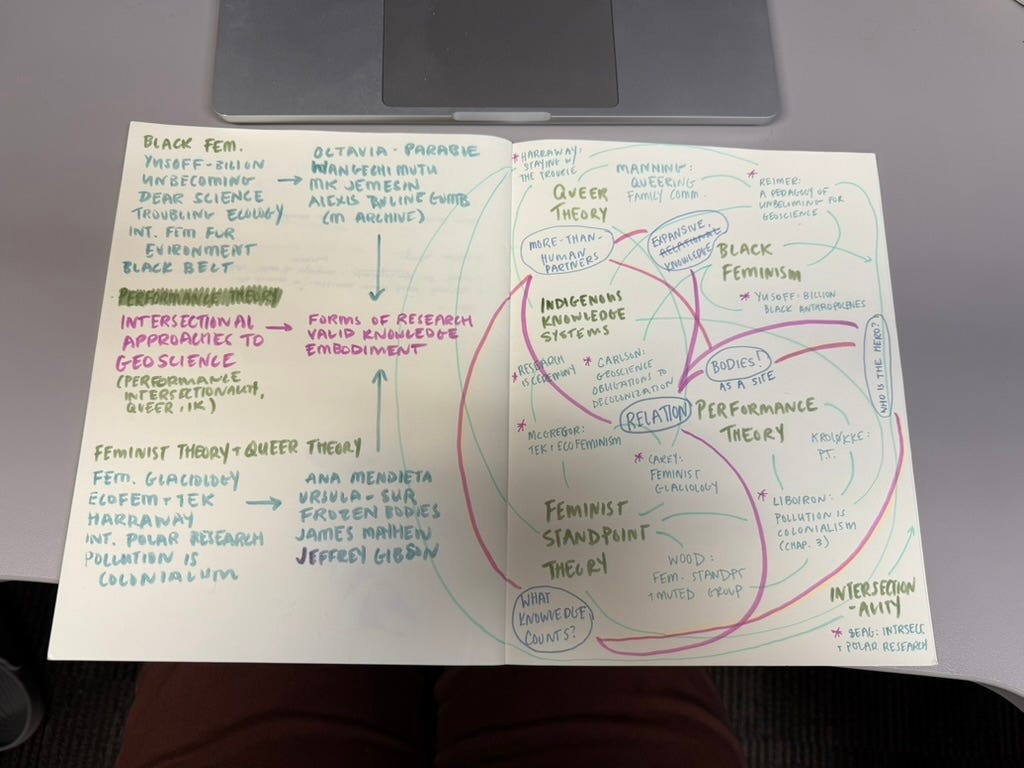
I take those maps and convert them into a more traditional outline, using the quotes and references from the research. I have also been using some AI tools* to help me translate my notes into full sentences, and then I edit, rewrite, rethink from there. It has been a game-changer for my visual/scattered/ADHD brain. I used to think that I just wasn’t smart enough to write coherently or efficiently, but I think it is mostly that huge translation hurdle from swirling webs of connections into sentence-form that is the biggest issue for me. Having basic sentences from my notes feels like a baseline that then I can mold and shape and trim and transform. *I continue to feel very conflicted about the environmental/social implications of this and it’s a work in progress.
What I didn’t realize about writing until very recently, and something I feel really empowered by, is that writing can just be a tool in service of my idea? Maybe this sounds obvious, but truly this has been a really big discovery for me and has felt really freeing! I have been feeling much more interested in writing as a practice when I treat it that way.
News + Upcoming Stuff
I am burying the lede, I know, but this is a good segue to mention that I have some writing out in the world! In addition to a few other co-authored papers-in-progress, I wrote a chapter about my work with JIRP for a book that was published in December:
I’m so honored to be in this collection with so many interesting artists and authors. Hilariously I don’t have a copy of the print book or the ebook (permissions and licensing are confusing!), but here is the official summary for my chapter:
Blueprints and the Topography of Loss: Integrating Artistic Practices into Glacier Science Education and Research with the Juneau Icefield Research Program
This chapter examines the interdisciplinary practice of Hannah Perrine Mode, whose work integrates art, design, teaching, and creative research to deepen human engagement with Earth systems and polar science. It explores the role of artistic methodologies in enhancing the communication of climate science, particularly in the context of glacier retreat, and underscores the significance of interdisciplinary and collaborative approaches in addressing the global climate crisis. Drawing on the author’s experiences with the Juneau Icefield Research Program (JIRP), the chapter demonstrates how the incorporation of creative practices into scientific inquiry can enrich educational and research endeavors in polar science. A visual framework is presented to illustrate the application of artistic methods in data collection, synthesis, outreach, and public engagement. Additionally, the chapter highlights specific examples of the author’s art-making and pedagogical initiatives within JIRP, emphasizing the fluidity between traditionally siloed disciplines and the potential for interdisciplinary approaches to foster deeper understanding of glacial environments and climate systems. Ultimately, this chapter advocates for the integration of creative methodologies as a means to cultivate empathy, enhance science communication, and promote environmental stewardship, thereby facilitating broader and more inclusive engagement with Earth science.
I wrote this before I started my PhD work, but it is definitely part of what I’m working on here at UAF.
Since I have organically reached the news part of this newsletter, here are some quickie professional updates:
Incredibly honored to be selected as one of the artist-fellows for the In a Time of Change: Coastal Transitions program here in Alaska over the next two years. More info here.
My show at Northeastern closed in December. I feel really proud and fulfilled of what I was able to pull off and put together with the support and collaboration with the team there, especially friend and curator-extraordinaire Juliana Barton.
I packed up as much cyanotype fabric and ceramic knots as I could fit in my bags and flew them back to Fairbanks yesterday. There were some knot casualties, but many survived the journey. I’ll be installing work in a three-person alternative photo show with JR Ancheta and Alice Bailey at the Well Street Gallery in Fairbanks in March.
I’m flying back to NY in February to co-teach my beloved creative retreat, Little Nights Big Weekend.
I’m already starting to mentally prepare and plan out my summer fieldwork and art projects, but I will leave that for another post.
In general, I’m going to try to send these out (hopefully) once a month this year with this type of unpolished, slightly rambly update, along with some WIP ideas, objects, writing, etc.
Recent Writing:
Feeling nervous to share this type of work, but in the spirit of process-over-perfection, here are a couple excerpts from some academic writing I have been working on this past semester.
from Art as a Systemic Actor for Cultural Humility, Knowledge Braiding, and Community Resilience in Alaska
These [Alaska Native] artists* exemplify undisciplinarity – moving fluidly across domains, methods, and epistemologies in ways that resist disciplinary containment. Their practices demonstrate the epistemological agility described by Haider et al. (2018), shifting between material experimentation, cultural storytelling, political critique, and ecological observation without privileging one mode of knowledge over another. In doing so, they model an iterative, reflexive approach to environmental inquiry that is grounded in methodological rigor yet expansive enough to accommodate Indigenous worldviews, relational ethics, and sensory or affective ways of knowing. At the same time, their work embodies cultural humility. Rather than positioning themselves as authoritative interpreters of environmental change, these artists attend to relationships – with Elders, community members, more-than-human beings, and place itself – as sources of guidance and accountability. Cultural humility becomes both ethic and method: a disciplined practice of listening, deferring, and responding that resists extractive forms of artistic and scientific engagement.
Together, these qualities allow their work to function as a boundary-spanning force. Their art moves across scientific, Indigenous, creative, and policy spheres, generating shared languages and relational bridges that make cross-epistemic dialogue possible. Their practices connect local lived experience with broader regional, national, and global concerns, amplifying place-based knowledge into arenas where climate narratives and policy decisions take shape. In this way, they help reconfigure who participates in environmental knowledge-production and how that knowledge circulates. Through undisciplinarity, cultural humility, and boundary-spanning practice, these artists reveal art’s capacity to reshape sustainability science itself – broadening what counts as expertise, how learning occurs, and what forms of future-making become imaginable.
* I was looking at the artwork of Sonya Kelliher-Combs, Nicholas Galanin, Crystal Worl, Linda Infante Lyons, Michaela Goade, Amber Webb, Jerry Laktonen, and Da-ka-xeen Mehner as case studies for generating place-based knowledge that supports cultural, ecological, and economic sustainability in Alaska.
from: Black Feminist Geologies: Unbecoming through Excavation, Empathy, Embodiment, and Entanglement
Embodiment centers the body as a site of knowledge, revealing how claims of scientific neutrality depend on disembodiment while regulating which bodies are granted legitimacy. Organizational and scientific norms privilege the abstract knower – an ideal that excludes emotion, reproduction, care, and sensory experience from legitimate knowledge production (Acker, 1990). Creative practices disrupt this abstraction by foregrounding embodied, affective, and sensory modes of knowing.
Black feminist geohaptic scholarship extends embodiment beyond the human scale, emphasizing tactile and sensory engagement with geological processes. Tanaka (2023) describes geohaptics as an “extreme intimacy of ecological entanglement” in which bodies and environments are continuously re-formed through touch, perception, and transformation (p. 572). In M Archive, Gumbs imagines geological knowledge through haptic relation, where earth becomes a site for “[scaling] the edges of our knowing” (Gumbs, 2018, p. 139) rather than mastering it (Tanaka, 2023).
Recent Reading
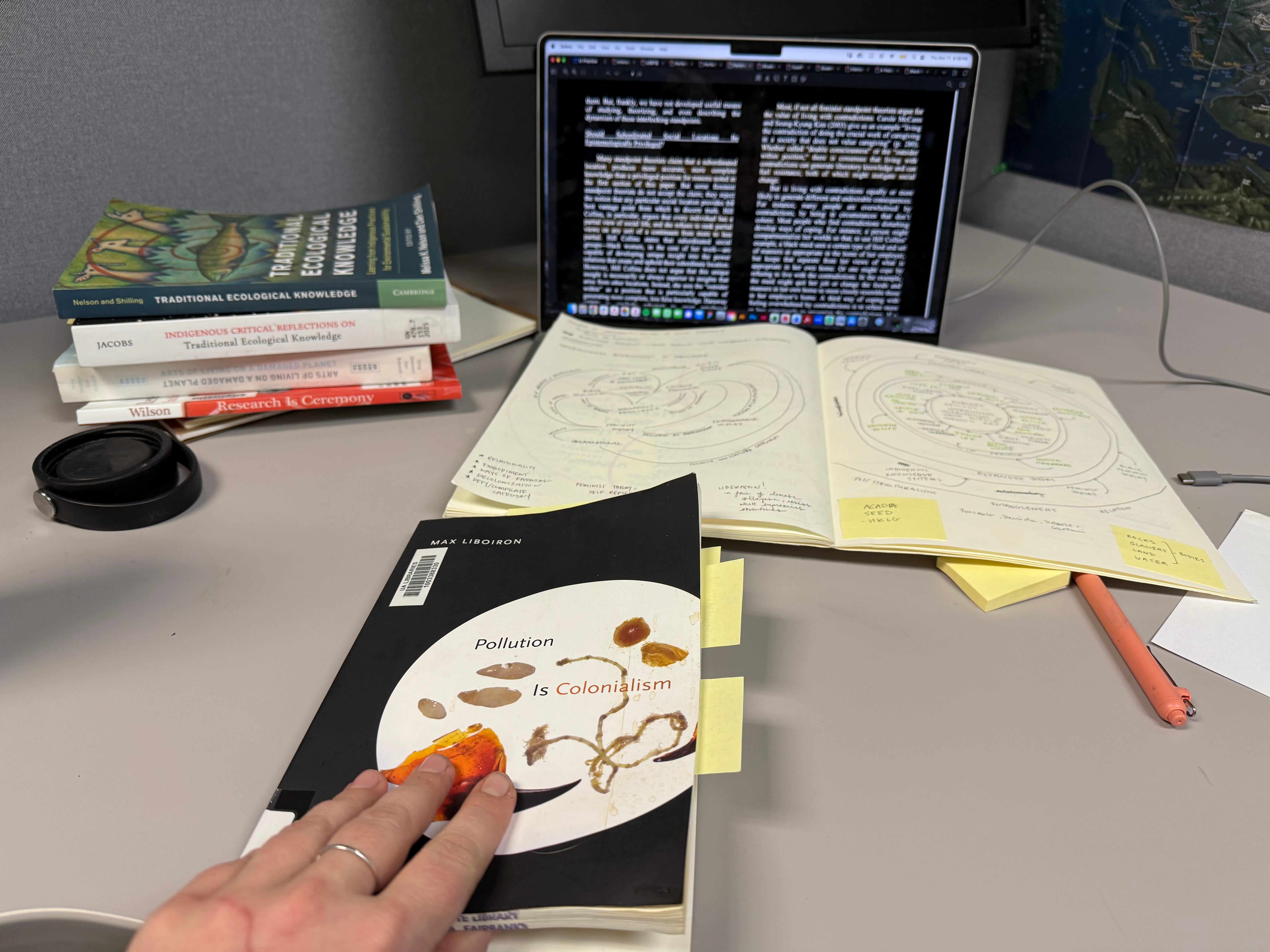
For work:
Research is Ceremony by Shawn Wilson
Pollution is Colonialism by Max Liboiron
M Archive by Alexis Pauline Gumbs
For fun (audiobooks):
Shield of Sparrows by Devney Perry
We Are All Guilty Here by Karin Slaughter
Recent Looking [at]
The Unknown Country - I watched this on the plane home and I can’t stop thinking about the quiet and downright luminous performance by Lily Gladstone.
Gorgeous and very contemporary-feeling Chinese Quilts at MFA Boston.
My favorite comfort show, The Great Pottery Throw Down is back! I watch the episodes as they come out at this random free link. It is quirky and creative and honestly watching a grown man cry with joy and pride about a ladle really feels like a balm for…everything going on in the world right now?
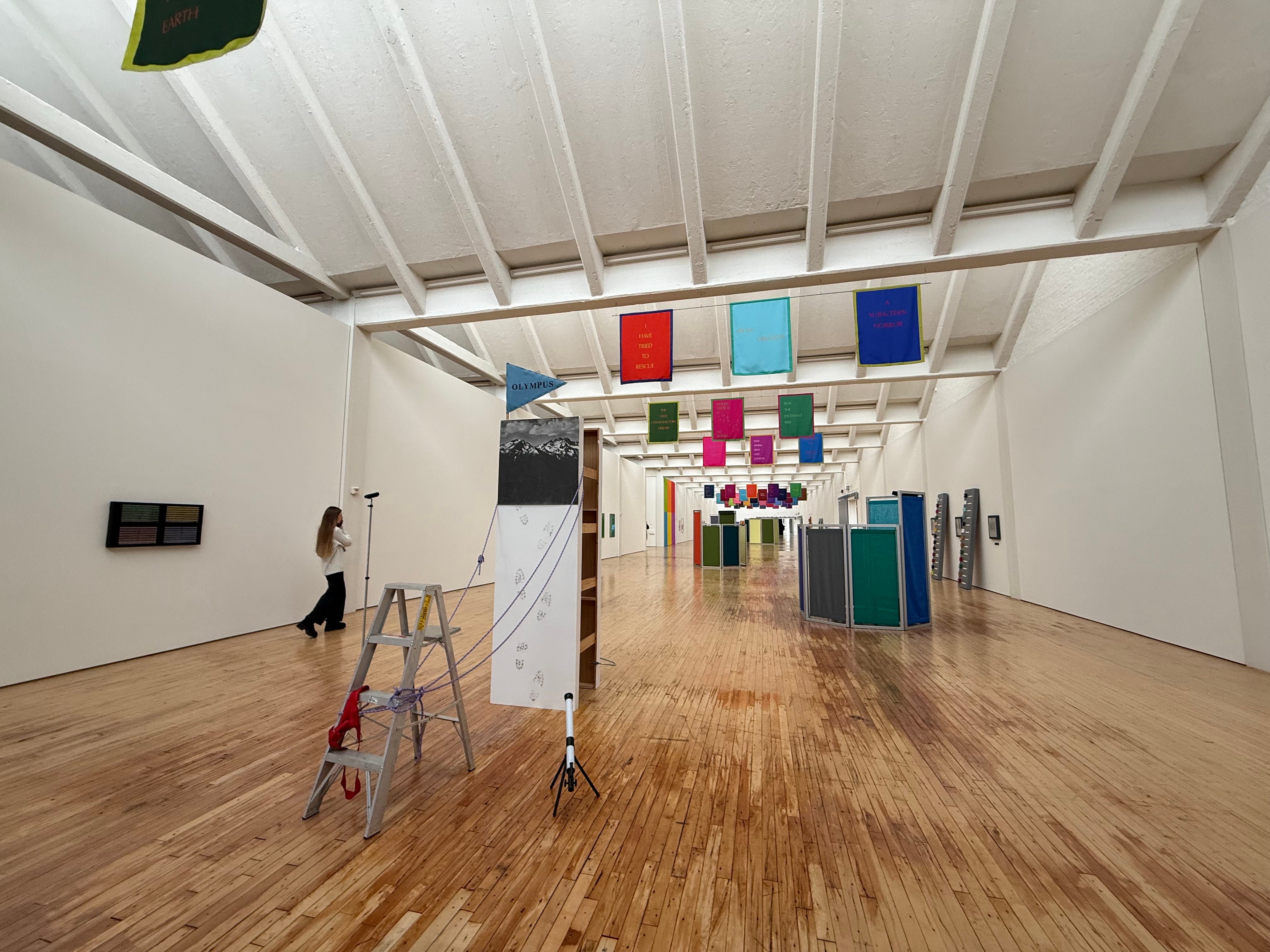
Renee Green’s show at Dia: Beacon - I loooooooved it and spent so much time wandering through it during a quick trip over my break.
Recent Making
Been making knot earrings out of polymer clay and having an absolute blast. I also made linocut holiday cards, am knitting a hat for the first time, and made my niece a set of farm animals out of polymer clay for christmas. :’)
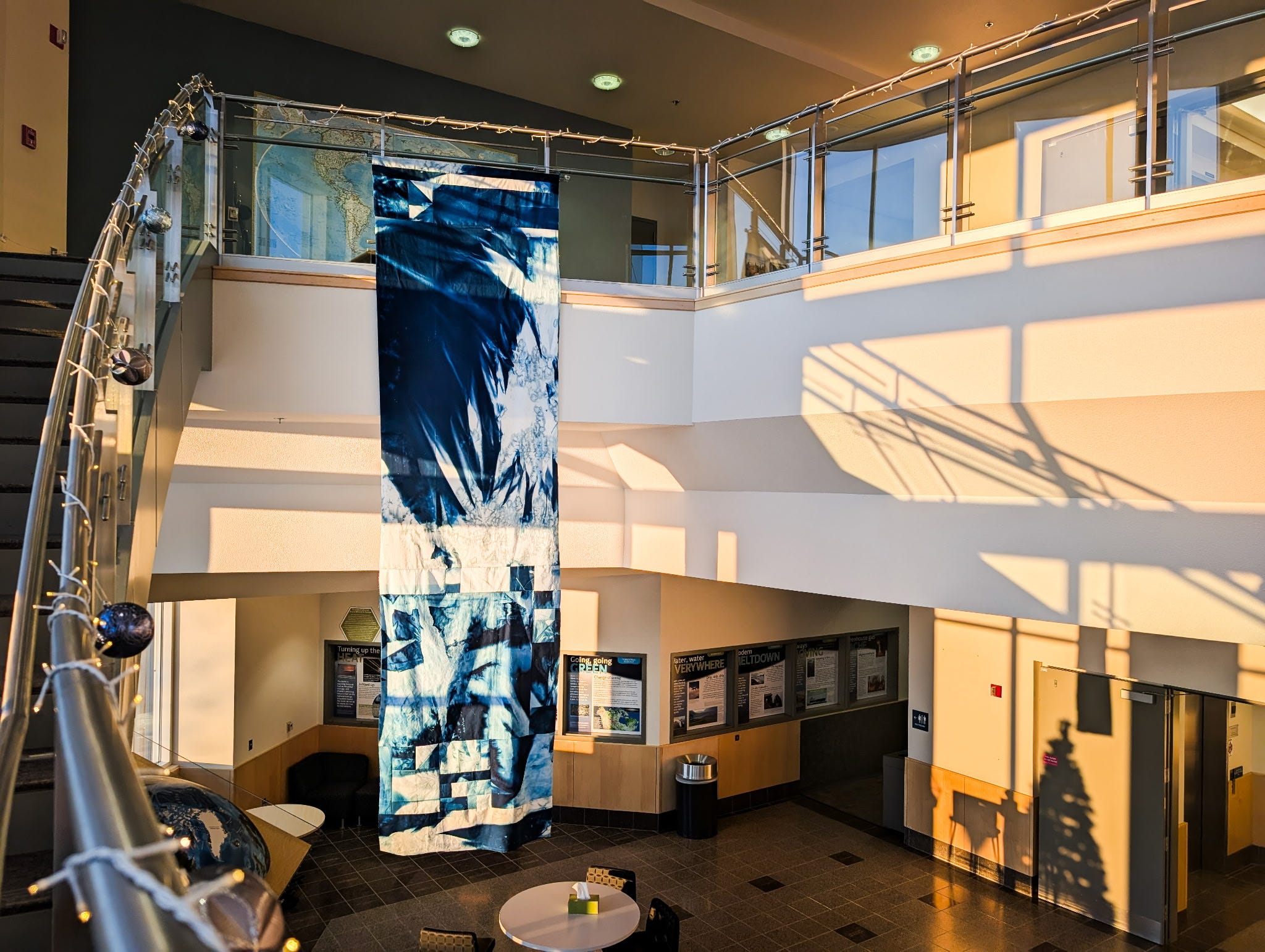
In December I finished and installed a giant cyanotype quilt and a few small pieces in the lobby of the building where I work (the International Arctic Research Center at UAF).
That’s all for now! Thanks for making it this far. I would love to hear from you if you have time to drop me a line via email, phone, or snail mail.
Lots of love,
Hannah